


Clean Implant: Why Is It Important to Me in Implant Treatment?
When choosing an implant, I pay attention not only to what we use, but also to the surface of the implant itself.
After many years of practicing dentistry, you come to understand more clearly that the success of a treatment depends not only on what procedure we perform, but also on how we perform it and which materials we use.
For me, implant treatment is not simply about placing an implant to replace a missing tooth. The implant’s material, design, surface characteristics, manufacturing process, and surface cleanliness are all factors I consider when planning treatment. This is because an implant is a medical device that is placed inside the body and comes into direct contact with the bone.
For this reason, in line with the biological and holistic approach to dentistry that I have embraced for many years, I believe it is important to evaluate the implants I use from a broader perspective.
What Is Clean Implant?
The Clean Implant Foundation provides an independent quality assessment approach focused on the surface cleanliness of dental implants and the potential contamination that may arise during manufacturing processes.
This is also the primary reason why I place importance on the Clean Implant approach. When choosing an implant, our patients quite understandably tend to ask questions such as:
“Which implant brand do you use?”
“Is the implant made of titanium or ceramic?”
“How durable is the implant?”
These are all important questions.
However, through my many years of work, particularly in the field of biological dentistry, there is another question that I believe deserves just as much attention:
“How clean is the implant surface?”
The part of an implant that comes into direct contact with the bone and surrounding tissues is its surface. Therefore, I believe that attention should be paid not only to the implant material, but also to its surface characteristics and surface cleanliness.
Why Is Implant Surface Cleanliness Important?
When discussing implant treatment, the focus is often placed on the implant brand, material, or mechanical properties. However, the implant surface is the first part to interact directly with the body. For this reason, foreign particles, manufacturing residues, or contamination that may occur on the implant surface during production are also important considerations for me.
One of the reasons I value the Clean Implant Foundation’s approach is that implant surfaces are not assessed solely based on manufacturers’ claims, but are also examined through independent quality evaluations.
As part of these assessments, implant surfaces are examined using advanced analytical methods, and their cleanliness is evaluated according to defined criteria. As a dentist, I aim to base the treatment plans I create for my patients as much as possible on scientific evidence, quality standards, and biological principles.
Clean Implant Certified Dentist Certification
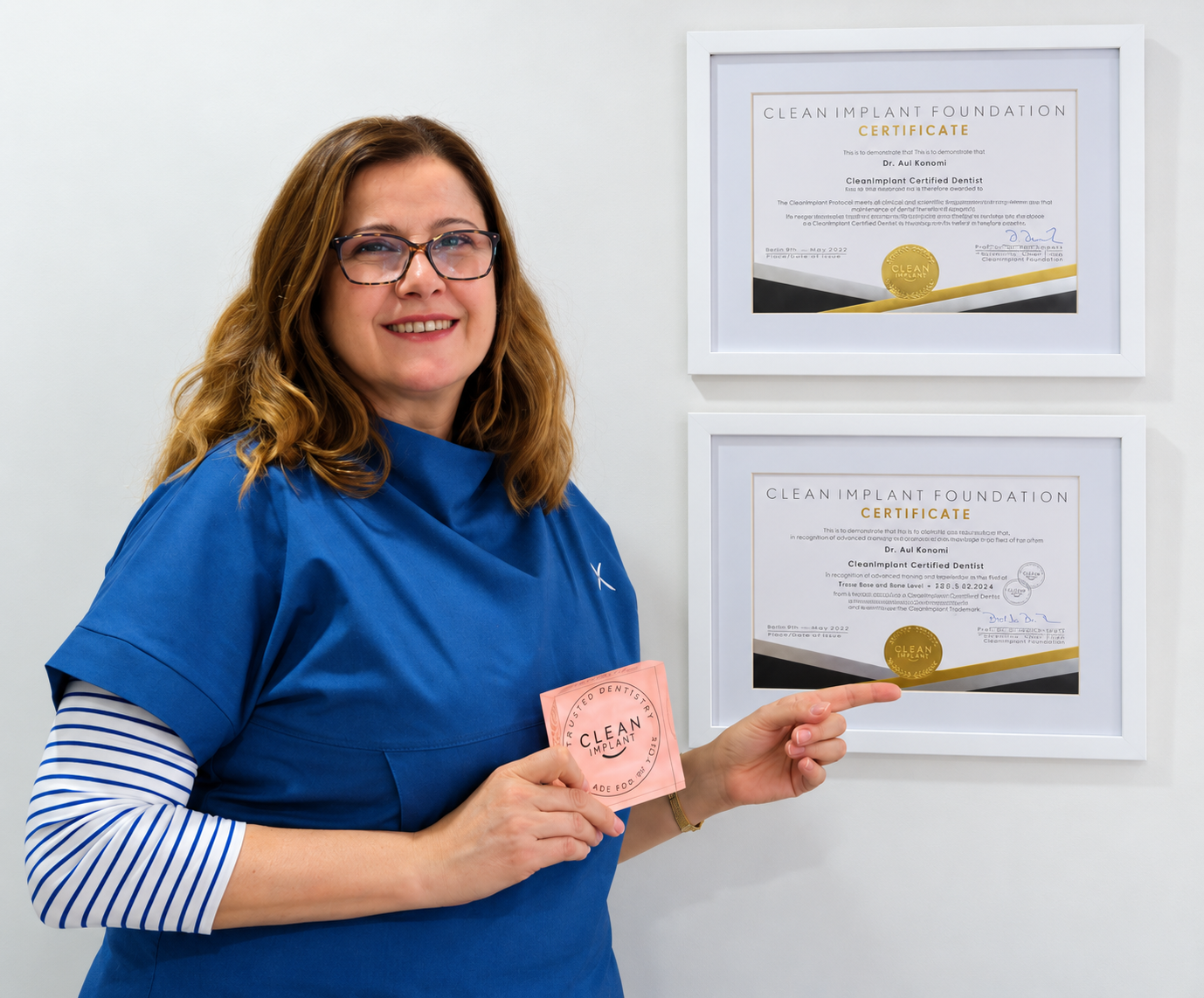
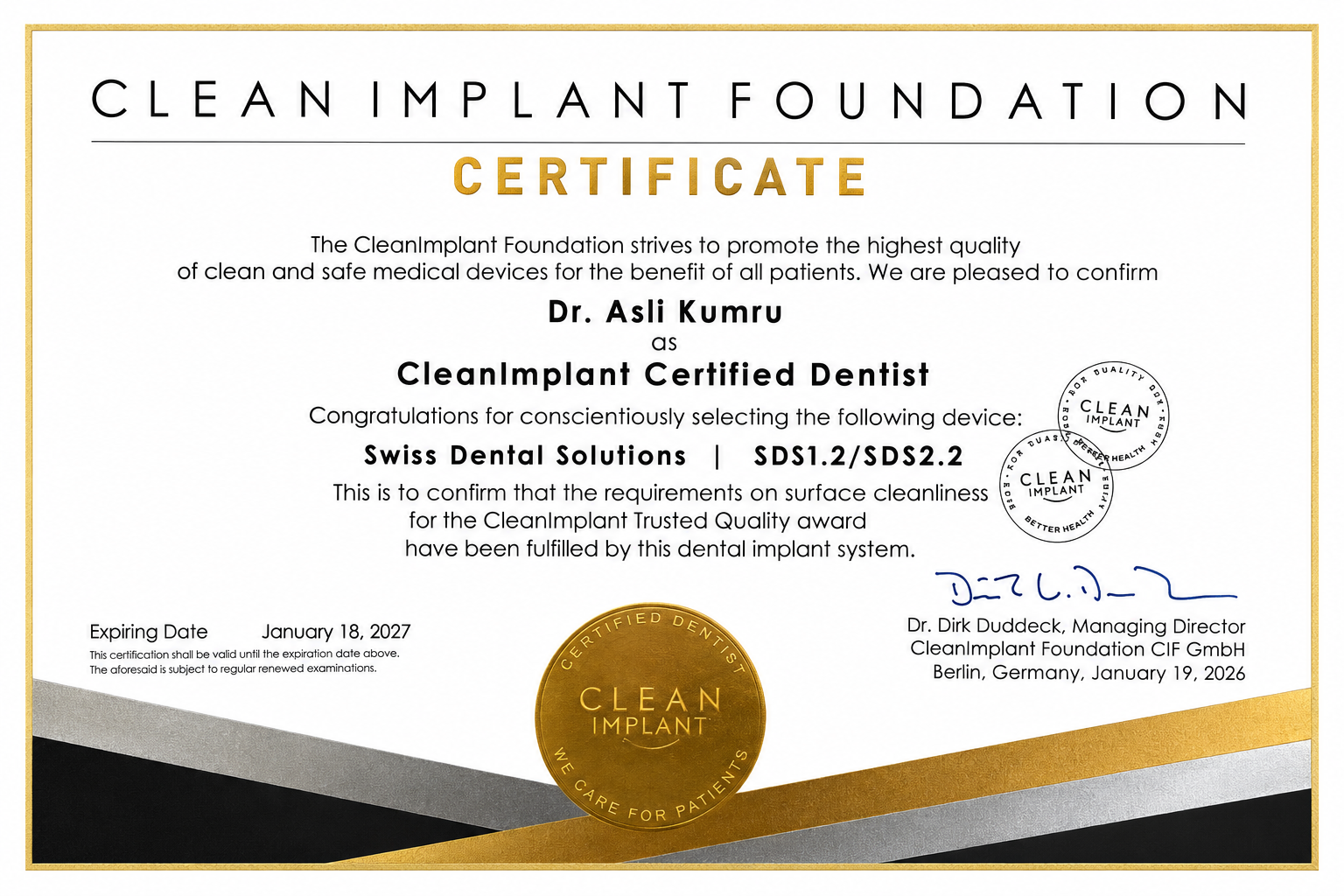
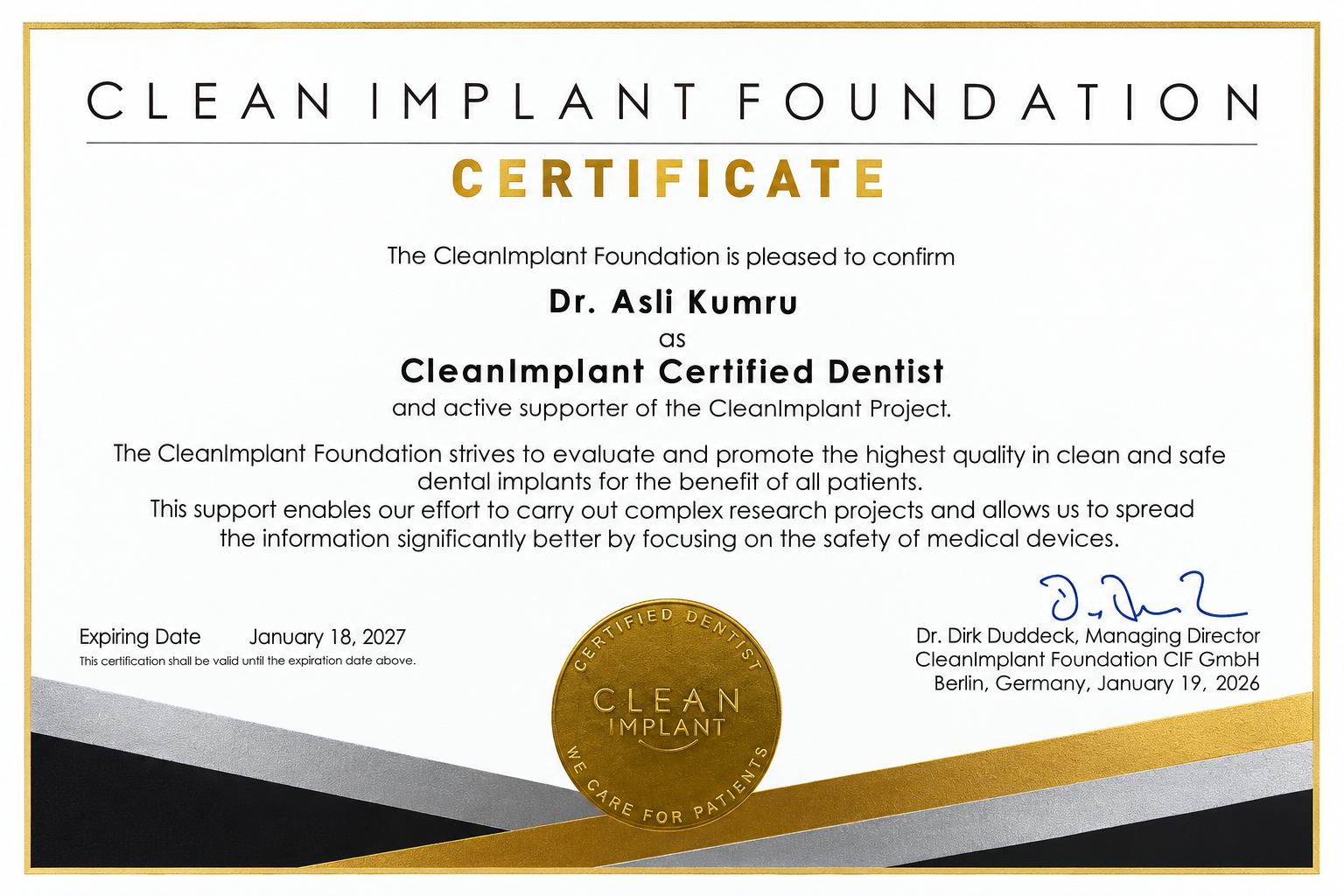
Receiving my Clean Implant Certified Dentist certification in 2026 represents much more to me than simply obtaining a certificate. I see it as an important complement to an approach I have advocated for many years, now applied specifically to implant treatment.
My certificate identifies the Swiss Dental Solutions | SDS1.2/SDS2.2 implant system and states that this implant system meets the relevant surface cleanliness quality requirements established by Clean Implant.
For me, the key point is this:
To evaluate the characteristics of the materials I use in my patients’ treatments as thoroughly as possible.
Because in biological dentistry, treatment is not simply about replacing a tooth. One of my primary goals is to provide treatment that the body can accept, that is compatible with biological principles, and that is appropriately planned for the long term.
What Does Clean Implant Mean to Me?
I view the Clean Implant approach as an additional level of attention devoted to cleanliness and quality in implant treatment.
When evaluating an implant, I do not simply ask:
“What brand is this implant?”
For me, all of the following questions matter:
- What material is the implant made from?
- What are the surface characteristics of the implant?
- How is the implant manufactured?
- How is its surface cleanliness evaluated?
- What are the biological properties of the implant?
- Are the patient’s individual biological conditions suitable for this implant?
- What is the condition of the bone and gum tissue?
- What is the patient’s overall health status?
- What is the long-term objective of the treatment?
Because every patient is different.
For this reason, rather than applying the same implant, treatment protocol, or approach to every patient, I believe that treatment should always be planned individually.
Ceramic Implants and Clean Implant Are Different Concepts
My patients often ask whether ceramic implants and Clean Implant refer to the same thing. In fact, they are two different concepts.
A ceramic implant refers to the material from which the implant is made.
The Clean Implant approach, on the other hand, relates to the cleanliness of the implant surface and the evaluation of potential contamination originating from the manufacturing process.
For me, these two approaches can complement one another.
Particularly within my biological dentistry approach, when evaluating ceramic implants, I consider not only the implant material itself but also its surface characteristics and manufacturing quality.
My objective is not to recommend a particular material unconditionally to every patient. I believe the most appropriate approach is to first assess the patient’s individual needs and biological conditions, and then determine the most suitable material and treatment method.
What Have More Than 30 Years of Clinical Experience Taught Me?
After completing my dental education in 1990, I have closely followed evolving treatment approaches, materials, and technologies throughout my professional career. Since establishing my own clinic in 1993, I have accompanied thousands of patients through their treatment journeys. During this time, I have witnessed significant changes in the field of dentistry.
One of the most important lessons my professional experience has taught me is this:
“The success of a treatment depends not only on performing the procedure correctly, but also on providing the right treatment for the right patient.”
That is why, when a patient comes to me for implant treatment today, I do not focus solely on the missing tooth.
I also evaluate the patient’s general health, oral and gum health, bone structure, existing restorations, medications, lifestyle, and expectations from treatment.
Because for me, implant treatment is much more than a surgical procedure.
I Approach Implant Treatment from a Biological Perspective
Within my philosophy of biological dentistry, preserving natural tissues whenever possible, evaluating biocompatible materials, and considering the patient as a whole are extremely important.
For this reason, I do not view implant treatment simply as:
“Replacing a missing tooth with a new one.”
I believe treatment should be planned by evaluating surgery, biology, materials, function, aesthetics, and the patient’s overall health together.
The Clean Implant approach also draws attention to an aspect of implant treatment that is often overlooked, but which I consider highly important:
The implant surface.
What I Recommend to My Patients Before Implant Treatment
If you are considering implant treatment, do not ask only about the price or the implant brand.
I also recommend asking your dentist the following questions:
“What material is the implant made from?”
“What are the surface characteristics of the implant?”
“How is the cleanliness of the implant surface evaluated?”
“Why is this implant suitable for me?”
“Are my bone and gum conditions suitable for this treatment?”
“How are you planning this treatment for the long term?”
I believe that being a well-informed patient is a very important part of the treatment process.
I always encourage my patients to ask questions about the treatment they will receive and to understand each stage of the process.
What Clean Implant Means to Me Most
For me, the Clean Implant approach means “thinking more carefully and asking more questions.”
It means not evaluating an implant solely according to its brand or material, but considering the implant surface, manufacturing quality, biological characteristics, and the patient’s individual circumstances together.
Because every material we place inside the mouth interacts with the patient’s tissues.
In line with the biological dentistry approach I have followed for many years, I place great importance on ensuring that this interaction is as appropriate and harmonious as possible.
A More Informed Approach to Implant Treatment for My Patients
For me, being a Clean Implant Certified Dentist is not an endpoint. It is part of an ongoing commitment to evaluating quality, biology, and patient safety more carefully in implant treatment.
I believe that every patient has different needs.
For this reason, I do not believe there is a single universal solution in implant dentistry. The appropriate treatment should be determined according to each patient’s biological and clinical conditions.
For me, successful implant treatment means providing the right treatment to the right patient, at the right time, with the right material, under the right biological conditions, and with the right treatment plan.
And at the centre of all these decisions is always my patient’s health.
About My Clean Implant Certification
My Clean Implant Certified Dentist certificate identifies the Swiss Dental Solutions | SDS1.2/SDS2.2 implant system.
The certificate states that this implant system meets the surface cleanliness quality requirements defined by the Clean Implant Foundation.
This certification indicates that the implant surface has been evaluated according to specific quality and cleanliness criteria.
It does not, by itself, guarantee the success of implant treatment or any particular clinical outcome.
As with every implant treatment, the treatment decision is made based on the patient’s clinical examination, bone and gum condition, overall health, and individual needs.
“For me, implant treatment is not simply about replacing a missing tooth. It means considering my patient’s biology, the materials we use, and the long-term outcomes of the treatment together. The Clean Implant approach is an important evaluation criterion that supports this perspective by placing particular emphasis on the cleanliness and quality of the implant surface.”
Dentist Aslı Kumru